IN CASE YOU SEARCH FOR DEATHWORMS IN MONGOLIA
Go in June or July, those wet days known as the worm’s active months. Start from Ulaanbaatar toward South Govi, reaching Khongoryn els. Take an off-road vehicle, several hundred miles over terrain going green to brown, steppe to rock desert, herds of antelope, little else.
Pack tools. Camera, electric motor and motor controller, explosives and detonator, a journal, drafting pencils and paper, first aid kit, GPS, gifts for the villagers (candy and cigarettes), a knack for line of sight navigation, dark glasses, an appetite for mutton.
Ask every villager you encounter about the worm. The villagers will be mostly older than you, gaunter, lighter in the sand, capable of standing heat, cold and vodka in ways you never could. They will urgently fill your tea bowl. They will ask why you care about the worm. Understand that any answer you offer will likely mean little. Listen more than you speak. Have a gift to exchange for what you hear.
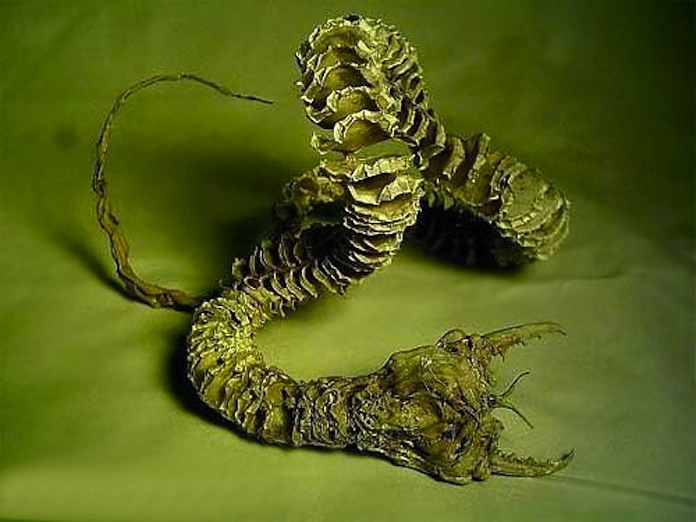
Know they won’t say much about the worm. Expect tea, fermented milk, vodka, salty Gobi well water, rolled cigarettes and cattle anecdotes. See the worm as a bonus. Hear it described as a rolling cow intestine, a flaming liver, poisonous salami. Find it mostly in the form of camel stories. Herds of electrocuted camels, or camels doused in poison squirted from under a patch of sand. And stories of the boy—the young boy playing with the yellow toy box. And the worm that crawled inside the toy and killed the boy instantly when he reached inside. Find several versions of this story. At the end of each version find this comment: the worm is attracted to yellow.
Seek out the oldest man in each village. He will claim to know the worm best. Ask him to pinpoint precise locations on your map, where the worm most likely unburies. Spots where goyo best blooms and the ground’s most wet. With this map of points, create a tabulated chart. Cross-reference locations, descriptions and stories. Follow what correlates.
Accept the tent that one old man offers you. Trust when he warns you to go no further without it. Trust when he says it’s stronger, more capable than it looks, more capable than your sleek REI gear. Don’t mind its design—child’s colors, dotted with small clowns and bears.
Trek a minimum of 6 hours per day. Two hours after breakfast, two after lunch and two after dinner. Anticipate the heat and disorienting sand storms. When trekking, always bring your attention to the Gobi Desert. The barren gravel plains, the dust plums, impossible chasms. Know the worm’s earth includes few intelligible lines between sky and ground, no good guides to keep your feet flat and hands well occupied. Just one long sand color and an occasional musk ox criss- crossing the dunes.
Meet a shaman, or several. Always when expecting no one on the horizon. Ask him to describe the worm—something worth correlating and pinning to your map. But don’t expect much. Know you might only receive a frown. You might only receive him saying: to be where you have gone, where you want to go, you’re violating the taboo of the desert. This thing you chase is no living creature. No, this is an evil beast, the Demon of the desert. Take his snuff when it’s offered. Snort as he instructs. Feel alive. Listen when he says he’s afraid. Listen when he says you’ll see. Offer him a gift in return.
Expect nausea, swollen bruises, hematomas and nightmares of purple sand dunes that threaten to swallow you. Expect wolf tracks, airborne ticks, spiders under your water container and biting flies. Expect to not know your body. Anticipate a suffocation of your pace. Expect heavy legs and weak arms. Words will come slow and sometimes hardly at all. Thoughts will move like bile up from labored organs. Your breath like a mucus from some deep cavity. Spend as much time in the tent as needed.
Anticipate you’ll see the boy with the yellow truck. Find him, perhaps, while on a trek, kneeling behind the goyo plants. Or, while lying in your tent. His silhouette, breathing were the air glows beyond the clowns and bears. Or, while climbing a sandstone cliff. See the sand ahead and behind and the boy with the yellow toy truck peeking from some dark space. Anticipate his absence whirling. Keep the boy there, running parallel to you. Allow him to stay. Discover him from time to time.
Continue to trek. Come to that point on your map, where the most points meet. That highest degree of correlation, down and over a ridge of sandstone. As you reached the valley edge, feel the heat, feel what disrupted life looks like—a spread of drought-victims—carcasses in the basin. Feel alive. Feel the constant rediscovery of existence.
Here. Set up the camera, place your explosives, pound the sand with your tired fist, thump the sand with your weak legs, detonate your small buried explosives, hope for deep vibrations, hope to stimulate the worms to the surface, watch the sand shudder, capture it through the small round lens of your camera, listen to the blood of your heart firm in your ears, want anything—just some sign, want to know what the sand’s blown over, peeking from some dark space, its absence whirling, know its okay to be afraid.